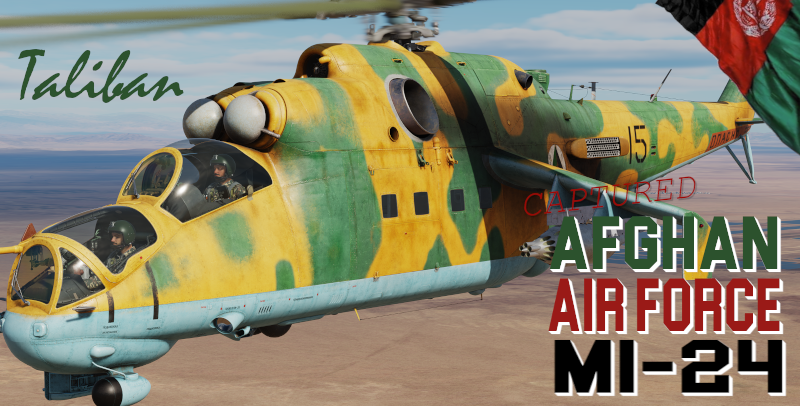
My competition entry 3 for Mi-24P Hind Livery Competition 2024
Taliban captured Afghanistan Air Force Mi-24 1996
Includes historical weathered yellow scheme, pilots with mustaches, 2 digit numbers and gray exhaust IR suppressors
Countries: Afghanistan, Insurgents
Because there are no decal changes these will work as Afghan Air Force planes too. Pilots usually just switched sides to whoever was in control when regime got changed or they defected so there is no need to draw long beards for these guys anyway. Idea here is to allow creation of scenarios for both AAF and Insurgents with planes that were historically actually flown or could have been flown by both sides during late 80's war period and 90's
The Mil Mi-24 and Mi-35 (export model) attack helicopters have a long history in Afghanistan. The aircraft was operated extensively during the Soviet-Afghan War, mainly for attacking mujahideen fighters. Early in the war, the only anti-air weapons of the mujahideen were Soviet-made, shoulder-launched, heat-seeking SAMs and American Redeye, which had either been captured fr om the Soviets or their Afghan allies or were supplied by Western sources. Many of them came from stocks the Israelis had captured during their wars with Soviet client states in the Middle East. Owing to a combination of the limited capabilities of these early types of missiles, poor training and poor material condition of the missiles, they were not particularly effective.[8] Beginning in 1986, the US supplied the mujahideen with its state-of-the-art heat-seeking missile, the FIM-92 Stinger, which the Afghans employed with devastating effect. In the first use of the Stinger in Afghanistan, mujahideen fighters downed three of eight unsuspecting Soviet Mi-24 Hinds as they approached the airfield at Jalalabad on a late September afternoon. Some scholars point to that event in 1986 as the turning point in the war. Moreover, for most of the remainder of the war when Stingers were known to be present, Soviet and Afghan aircraft elected to remain at higher altitudes wh ere they were less vulnerable to the missile, but also less effective in ground attacks. Although employed extensively throughout the war as a ground attack platform, the Hind suffered fr om a weak tail boom and was found to be underpowered for some missions it was called upon to perform in the mountains of Afghanistan, wh ere high density altitude is especially problematic for rotary-wing aircraft.
Overall, the Hind proved effective and very reliable, earning the respect of both Soviet and Afghan pilots as well as ordinary Afghans throughout the country. The mujahideen nicknamed the Mi-24 the "Devil's Chariot" due to its notorious reputation.
After the Soviet withdrawal and the departure of foreign advisors, the Air Force declined in terms of operational capability. With the collapse of the Najibullah Government in 1992, the Air Force splintered, breaking up amongst the different mujahideen factions in the ongoing civil war. By the end of the 1990s, the Taliban maintained five supersonic MiG-21MF and 10 Sukhoi Su-22 fighter-bombers. They also held six Mil Mi-8 helicopters, five Mi-35s, five L-39Cs, six An-12s, 25 An-26s, a dozen An-24/32s, an IL-18, and a Yakovlev. The Afghan Northern Alliance/United Front operated a small number of helicopters and transports and a few other aircraft for which it depended on assistance from neighboring Tajikistan.
Perhaps the most important question many were asking was how the Taliban – a radical movement that had been employing mostly unsophisticated weapons – learned to fly their newly captured mounts. The answer was an easy one, though: as had happened in Afghanistan several times before, in the times of a regime change, part of the Afghan Air Force would simply side with the winning party, which this time happened to be the Taliban.