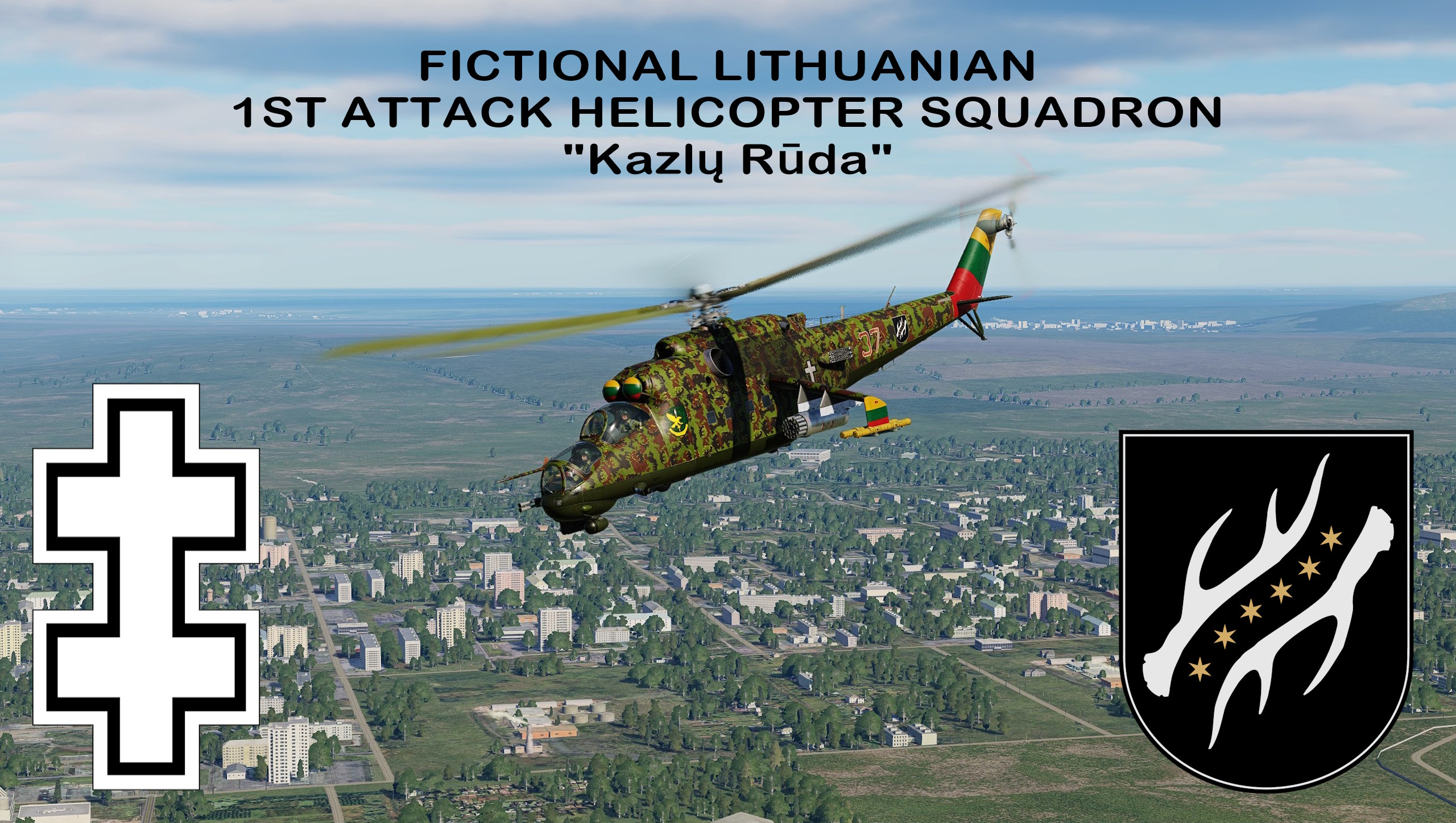
Fictional Lithuanian M05 Eglutė camouflage for Mi24P
Created a Lithuanian livery for Mi24P based on Old Infantry camo pattern called M05 eglutė.
The M05 “Eglutė” is a Lithuanian Armed Forces camouflage pattern introduced in the mid-2000s.
Its name eglutė means “little spruce,” referring to the small, repeating spruce-tree shapes in its design.
Type: Disruptive digital camouflage.
Colors: Typically dark green, light green, brown, and black, optimized for temperate forests.
Purpose: Suited for Lithuania’s mixed woodland terrain and seasonal foliage.
Usage: Primarily for infantry uniforms, but also seen on gear, vehicles, and field equipment.
The Baltic Deal: How Lithuania Got Its Hinds
An Untold Tale from the Wild 90s — Belarus Edition
It was 1993, and Lithuania was just beginning to shake off the chains of Soviet occupation. The newly independent state was trying to build a military out of whatever it could find — a few border posts, surplus Kalashnikovs, and uniforms that didn’t match. The air force? A dream... unless someone found a miracle.
That miracle came from Belarus — a country that in the early 90s was a chaotic scrapyard of leftover Soviet gear, unpaid conscripts, and colonels more loyal to vodka than any flag.
Operation “Šarka” (Magpie)
The mission began with Captain Arvydas "Varnas" Dambrauskas, a fast-talking logistics officer with a background in helicopter maintenance and a reputation for “solving unsolvable problems.” His orders were unofficial: "Find us something that flies."
He drove into Belarus in a civilian van with Lithuanian plates, three mechanics from Panevėžys, and a trunk filled with American dollars, moonshine, and fresh smoked fish — diplomatic gifts of the very Baltic variety.
They made contact at Bobruisk Airbase, which by then was half-abandoned and run by a Belarusian “commander” who introduced himself only as Major Borya, wearing Adidas sweatpants, a Soviet officer’s hat, and no shirt. Borya offered them tea, sunflower seeds, and access to a forgotten hangar that still housed four Mi-24Ps, half-cannibalized, covered in dust, bird crap, and Soviet glory.
Borya scratched his chin and said:
“For you, brother... $25,000 each. But I throw in rockets if you bring me a color TV from Vilnius.”
The deal was struck in a barracks kitchen over shots of plum brandy. The paperwork? Written in pencil on the back of a training manual. The aircraft? “Reclassified as agricultural equipment.”
The Escape
Only one of the Hinds was flyable. Barely. The Lithuanians scavenged parts from the other three, swapped a tail rotor using a car jack, and sealed a hydraulic leak with chewing gum and a bootlace. They painted over the faded Soviet stars with spray-painted Lithuanian tricolors, stenciled on a crude Vytis knight, and named it “Kibirkštis” (Spark).
On a misty morning, Captain Varnas and his mechanic Žilvinas lifted off from a frozen potato field outside Babruysk. With no flight plan, no transponder, and zero clearance, they flew nap-of-the-earth through forests and over rivers, dodging power lines and border patrols.
Somewhere near the Druskininkai border, a Belarusian MiG-23 tried to intercept them but ran out of fuel. The Hind entered Lithuanian airspace at tree-top level and landed behind a barn near Alytus, greeted by a farmer who offered them mushroom soup and thought it was a movie shoot.
Official Statement
When Lithuanian authorities were asked by NATO observers about the Mi-24 suddenly flying over Vilnius during the State Day parade, they released a simple press statement:
“The aircraft was donated by a friendly state and restored by local specialists.”
No one believed them.
No one asked again.
Legacy
The original Mi-24P, “Kibirkštis”, flew until 2008. It participated in joint Baltic drills, SAR simulations, and once delivered spare parts to a stranded Latvian APC during a snowstorm.
It now sits in the Lithuanian Air Force Museum, patched with rust, bullet holes, and duct tape — a monument to the wildest decade of Baltic military improvisation.
As for Captain Varnas?
He now runs a bar in Nida called “Sraigtasparnis” (The Helicopter), wh ere he serves vodka in empty flare canisters and still claims,
“I could’ve brought two more… but the damn cow got in the way.”